Quartz Hill Furnace Flame Sensor Micro-Amp Testing & Cleaning
Published: November 15, 2026 | Reviewed by Matt Gore (CA Class C-20 Lic #1024283 • EPA Section 608 Universal)
How do I test my furnace's flame sensor for proper micro-amp output in Quartz Hill, and what are the signs of a dirty or failing sensor?
In Quartz Hill, CA (2,493 ft, CEC Climate Zone 14), furnace flame sensor testing typically runs $165–$690 flat-rate ($4,900–$9,800 for Ultra-Low NOx / LP furnace replacements) through Working Class HVAC (CSLB #1024283 | EPA 608 Universal), with the $89 meter-verified diagnostic credited into any approved repair. A properly functioning flame sensor should produce 1.5 to 5 micro-amps. We'll detail the precise steps for professional micro-amp testing, common issues like carbon buildup affecting conductivity, and the diagnostic process for short-cycling furnaces in cold CEC Climate Zone 14 conditions. Dispatched directly from 2232 West Avenue L across Avenue M, Avenue L, 50th Street West (10–18 minutes (immediate Westside home zone)), founder Matt Gore’s team backs every repair with a 1-year warranty at (661) 494-8075.
1. Engineering Breakdown: Why Quartz Hill Furnace Flame Sensor Micro-Amp Testing & Cleaning Demands High-Desert Precision
When property owners along Avenue M and Avenue L in Quartz Hill, CA encounter issues involving furnace flame sensor testing, generic sea-level troubleshooting guides routinely misdiagnose the root cause. A properly functioning flame sensor should produce 1.5 to 5 micro-amps. We'll detail the precise steps for professional micro-amp testing, common issues like carbon buildup affecting conductivity, and the diagnostic process for short-cycling furnaces in cold CEC Climate Zone 14 conditions. Operating inside CEC Climate Zone 14 at 2,493 ft (10.0% High-Desert elevation factor) during late november high-desert early freeze (28°f–34°f nights) subjects residential and commercial mechanical equipment to simultaneous electrical, aerodynamic, and thermodynamic extremes rarely seen in coastal Los Angeles basins.
Across half-acre to two-acre custom ranch estates, detached workshops, and dual-system properties, indoor blowers and outdoor heat-rejection coils must overcome 151°F–158°F summer roof-cavity radiation, 111°F peak dry-bulb ambient temperatures, and crisp 21°F winter radiational freezes. Meanwhile, open Westside ranch wind fetch driving fine quartz silica into outdoor condenser coils—driving abrasive PM10 and PM2.5 mineral particulates into contactor enclosures, inducer housings, and louvered condenser cabinets throughout ZIP codes 93536.
At Working Class HVAC (2232 West Avenue L, Lancaster, CA 93536 • CSLB #1024283), founder Matt Gore requires every service call for furnace flame sensor testing, flame sensor cleaning, and furnace short cycling to start with baseline instrument telemetry rather than parts-swapping guesswork. Recording exact supply-to-return Delta-T, static pressure in inches of water column, and component electrical draw protects homeowners from paying twice for misdiagnosed symptoms.
- Elevation & Air-Density Physics (2,493 ft): Every 1,000 feet above sea level reduces air mass flow, requiring 10.0% High-Desert elevation factor when evaluating heat-transfer CFM and gas/LP burner input.
- Thermal Envelope Reality: Unsealed return plenums inside 151°F–158°F Quartz Hill attics can pull raw superheated air directly across indoor coils, mimicking low-charge or limit-switch faults.
- Windborne Alkali Fouling: Just 1/16 inch of compacted Mojave silt raises condensing head pressures 40–65 PSI and spikes compressor amperage by 18%–26%.
- Zero-Commission C-20 Accountability: You see actual meter numbers on Fluke multimeters, Fieldpiece manometers, and combustion analyzers before approving a single dollar.
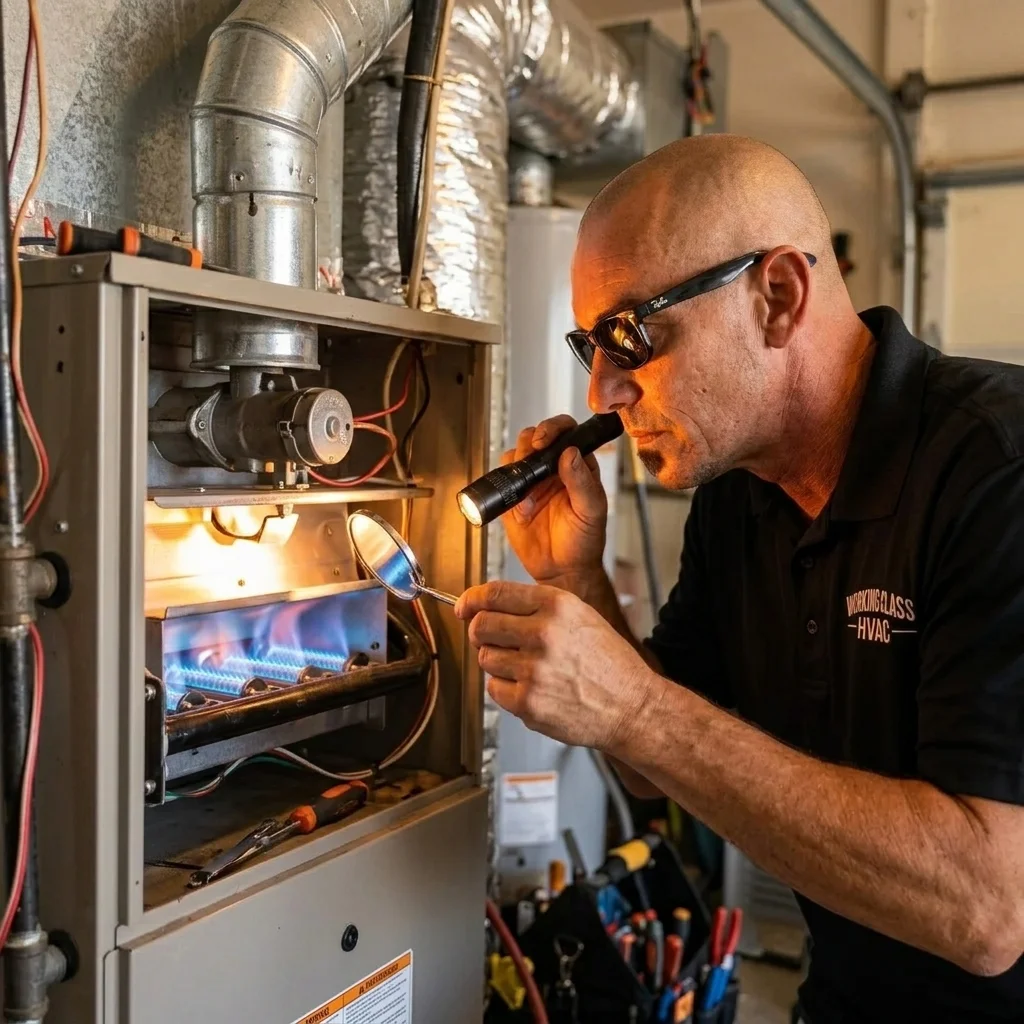
Quartz Hill, CA C-20 Diagnostic Telemetry & Flat-Rate Cost Matrix: Quartz Hill Furnace Flame Sensor Micro-Amp Testing & Cleaning (Day #3 Field Reference)
| Diagnostic Check / Repair Scope | Quartz Hill High-Desert Stress Factor | Verified Flat-Rate / Spec | Working Class HVAC C-20 Protocol |
|---|---|---|---|
| Primary Focus: furnace flame sensor testing | Late November High-Desert Early Freeze (28°F–34°F nights) (2,493 ft) | $165–$690 flat-rate | Digital manometer, ohm & micro-amp isolation |
| Silicon Nitride HSI & Flame Rod Circuit | 21°F overnight cycle fatigue | $165 – $365 flat-rate | Cold resistance (40–90 Ω) & 2.0–5.0 µA DC test |
| Inducer Draft Motor & Differential Switch | open Westside ranch wind fetch driving fine | $245 – $690 flat-rate | Dual-port WC draft test & flue termination clear |
| Gas / LP Manifold & Altitude Calibration | 10.0% High-Desert elevation factor | $220 – $560 flat-rate | 3.5" WC natural gas / 10.5" WC LP clocked input |
| HD Borescope Heat Exchanger & CO Audit | Heavy winter runtime in Quartz Hill | $89–$149 (waived w/ fix) | Articulating cell inspection & 0-PPM supply CO |
| SCAQMD Rule 1111 / LP Furnace Changeout | Title 24 HERS <=5% duct seal | $4,900 – $9,800 installed | Permit, sediment trap, plenum seal & 10-yr warranty |
2. Step-by-Step C-20 Field Diagnostic Protocol for Furnace Flame Sensor Testing
Answering "How do I test my furnace's flame sensor for proper micro-amp output in Quartz Hill, and what are the signs of a dirty or failing sensor?" accurately on site in Quartz Hill, CA follows a strict six-stage isolation sequence. First, our technician inspects line-voltage disconnect integrity (208/240VAC single- or three-phase) and 24VAC Class II control transformer output, checking for low-voltage rub-throughs caused by desert wind vibration or rodent activity near Avenue M.
Second, on gas and LP propane heating circuits, we connect a dual-port digital manometer across the induced-draft pressure switch to verify negative water-column pull exceeds the OEM closing threshold without flutter during gusty nights. We ohm-test silicon nitride igniters (confirming healthy 40–90 Ω cold resistance without hairline white silicon-dioxide fractures), measure steady 2.0–5.0 µA DC flame rectification current, and clock gas valve manifold pressure to 3.5 in. WC natural gas or 10.5 in. WC LP propane.
Third, we drill dedicated 3/8-inch plugged test ports before the indoor filter rack and before the evaporator coil to log total external static pressure. Whenever static pressure climbs past 0.50 in. WC—a frequent hidden culprit behind flame sensor cleaning and premature ECM motor module failure in Quartz Hill—we isolate whether the restriction sits in a matted 1-inch filter, an undersized return grille, a fouled secondary heat exchanger, or crushed flex ducting.
- Stage 1 — Safety & CO / Electrical Triage: Confirm 0 PPM ambient carbon monoxide, intact 3A/5A control-board fuse protection, and grounded disconnect lugs.
- Stage 2 — Component Bench & Live Load Verification: Test motor winding insulation resistance, capacitor MFD under load, igniter ohms, or thermistor temperature-resistance curves.
- Stage 3 — Static Pressure & Delta-T Mapping: Target 0.40–0.49 in. WC total external static pressure with 18°F–22°F cooling drop or 35°F–65°F nameplate heating rise.
- Stage 4 — Written Flat-Rate Scope Review: Present side-by-side immediate repair vs. preventive options with $89 diagnostic fee waived upon approval.
3. California Title 24 Part 6, HERS & Local Code Compliance in Quartz Hill, CA
Mechanical work performed across Quartz Hill, CA (93536) is governed by the California Mechanical Code, California Energy Commission Title 24 Part 6 standards, federal EPA Section 608 refrigerant regulations, and local air-district rules (AVAQMD / SCAQMD / EKAPCD depending on parcel jurisdiction). Unlicensed handymen skipping permits or venting/refrigerant protocols frequently leave homeowners with red-tagged escrow inspections, voided 10-year OEM warranties, or hazardous flue back-drafting.
Whenever furnace flame sensor testing transitions from a component repair into a condenser, coil, furnace, package unit, or major duct alteration (>25–40 linear feet), California Title 24 mandates third-party HERS (Home Energy Rating System) verification. That includes pressurized Duct Blaster testing to <=5% leakage on new R-8 duct systems (or <=15% on existing altered plenums), airflow verification (>=350 CFM per nominal cooling ton), and documented refrigerant charge verification.
Furthermore, transitioning refrigerant standards—moving from high-GWP R-410A toward low-GWP A2L refrigerants such as R-454B and R-32—require spark-free recovery pumps, active refrigerant dissipation sensors on indoor air handlers, dry-nitrogen purge brazing to eliminate internal copper-oxide scale, and standing digital vacuum decay tests below 310 microns. Working Class HVAC’s EPA 608 Universal certification ensures 100% compliant handling across every legacy R-22, R-410A, and next-generation A2L system in Quartz Hill.
4. 2026–2027 Quartz Hill Flat-Rate Cost Guide & Honest Repair-vs-Replace Math
Transparent pricing eliminates the stress of unexpected HVAC trouble during late november high-desert early freeze (28°f–34°f nights). Across Avenue M, Avenue L, 50th Street West in Quartz Hill, CA, Working Class HVAC prices furnace flame sensor testing from a standardized flat-rate book ($165–$690 flat-rate ($4,900–$9,800 for Ultra-Low NOx / LP furnace replacements)) rather than open-ended hourly billing. Whether traffic on SR-14 slows parts pickup or a rusted blower set-screw takes an extra forty minutes to extract, your approved invoice never creeps upward by a single cent.
How do you know whether to invest in flame sensor cleaning or put that money toward a high-efficiency SEER2/AFUE replacement? Matt Gore teaches Quartz Hill homeowners a clear engineering benchmark: multiply the system’s chronological age in years by the quoted repair dollar amount. If a 9-year-old split system needs a $320 electrical/sensor repair ($2,880 score) and passes borescope/megohm checks, repairing is an easy win.
Conversely, when a 16-to-20-year-old 10-SEER unit near Avenue L faces a $1,650+ R-22 evaporator leak, a grounded scroll compressor, or a cracked primary heat exchanger—while costing $380–$520/month on Southern California Edison (SCE) summer Time-of-Use tiers—upgrading to a 16–20+ SEER2 variable-capacity system or dual-fuel heat pump cuts peak kWh draw 30%–42% and locks in a fresh 10-year parts warranty with 0% OAC financing options.
- Minor Electrical, Sensor & Ignition Repairs ($165–$385): Capacitors, contactors, flame sensors, silicon nitride igniters, pressure switches, condensate float switches, and C-wires.
- Mid-Tier Airflow, Motor & Metering Repairs ($395–$1,150): ECM blower modules, condenser fan motors, inducer draft assemblies, TXV metering valves, and EPA 608 leak braze + recharge.
- Turnkey Title 24 Equipment Upgrades ($4,900–$16,900): Ultra-Low NOx/LP furnaces, 15.2–21 SEER2 split systems, rooftop packages, and multi-zone ductless mini-splits with HERS testing.
5. Homeowner Pre-Check Safety Steps & 24/7 Dispatch Across Quartz Hill, CA
Before our C-20 service truck pulls up to your driveway or loading dock in Quartz Hill, CA (10–18 minutes (immediate Westside home zone)), three safe 2-minute homeowner checks can prevent secondary equipment damage and speed up resolution. First, inspect your return air filter: if Mojave wind dust has bowed the pleated media inward, shut the system off until a clean filter is seated with airflow arrows pointing toward the blower cabinet.
Second, walk out to your outdoor condenser or check your furnace sight-glass LED blink code before resetting any breaker! Turning power off and on at the 240V sub-panel or furnace switch erases the stored diagnostic flash code (such as 3 flashes for pressure-switch open or 4 flashes for high-limit trip) that tells our technician exactly what happened at 3:00 AM. If you see frost or ice on copper suction lines, switch the thermostat to System OFF and Fan ON so the indoor coil thaws before our arrival.
Never bypass safety rollout switches, never jump low-voltage R-to-W/Y terminals with bare wire if you smell gas or acrid electrical insulation, and never attempt DIY refrigerant charging. Working Class HVAC answers (661) 494-8075 live 24 hours a day, 7 days a week from 2232 West Avenue L in Lancaster—serving Avenue M, Avenue L, 50th Street West and neighboring Antelope Valley communities with blue-collar honesty and master C-20 precision.
- Record Furnace / Air Handler LED Flash Codes First: Snap a quick smartphone video of blinking red/amber diagnostic LEDs through the sight glass before touching the power switch.
- Keep 24 Inches Clear Around Outdoor Units: Clear tumbleweeds, gravel wash, and stored items blocking louver intake around Quartz Hill side-yard condensers.
- Join the $199/yr Bi-Annual Priority Maintenance Club: Includes spring chemical coil wash + fall combustion CO safety tune-up, priority heatwave/freeze dispatch, and 15% off all flat-rate repairs.
Frequently Asked Questions: Quartz Hill Furnace Flame Sensor Micro-Amp Testing & Cleaning
How do I test my furnace's flame sensor for proper micro-amp output in Quartz Hill, and what are the signs of a dirty or failing sensor?
In Quartz Hill, CA (2,493 ft, CEC Climate Zone 14), furnace flame sensor testing typically runs $165–$690 flat-rate ($4,900–$9,800 for Ultra-Low NOx / LP furnace replacements) through Working Class HVAC (CSLB #1024283 | EPA 608 Universal), with the $89 meter-verified diagnostic credited into any approved repair. A properly functioning flame sensor should produce 1.5 to 5 micro-amps. We'll detail the precise steps for professional micro-amp testing, common issues like carbon buildup affecting conductivity, and the diagnostic process for short-cycling furnaces in cold CEC Climate Zone 14 conditions. Dispatched directly from 2232 West Avenue L across Avenue M, Avenue L, 50th Street West (10–18 minutes (immediate Westside home zone)), founder Matt Gore’s team backs every repair with a 1-year warranty at (661) 494-8075.
How fast can Working Class HVAC dispatch a C-20 technician to Quartz Hill, CA (93536)?
Our fully stocked service trucks roll directly from 2232 West Avenue L, Lancaster, CA 93536 with typical arrival windows of 10–18 minutes (immediate Westside home zone) across Avenue M, Avenue L, 50th Street West. Because we carry universal ECM motors, 35/5 MFD desert-grade capacitors, igniters, gas valves, and EPA 608 refrigerants on board, over 90% of calls are resolved in one visit.
Why does Quartz Hill's 2,493 ft elevation and CEC Climate Zone 14 weather impact furnace flame sensor testing?
Equipment in Quartz Hill, CA operates under 111°F summer highs, 21°F winter freezes, 10.0% High-Desert elevation factor, and open Westside ranch wind fetch driving fine quartz silica into outdoor condenser coils. Calibrating external static pressure to 0.40–0.49 in. WC and setting fuel/refrigerant pressures to altitude-corrected tables prevents nuisance lockouts and compressor overheating.
Is the $89 diagnostic fee waived when I approve furnace flame sensor testing with Working Class HVAC?
Yes. Whenever you approve our written flat-rate repair quote in Quartz Hill, CA (93536), the $89 instrumented diagnostic visit is 100% waived—you pay only the exact upfront flat-rate repair price with zero hourly surprises and a full 1-year parts-and-labor warranty.
Does Working Class HVAC handle permits, Title 24 HERS testing, and rebates in Quartz Hill?
Yes. As an active California Class C-20 HVAC Contractor (CSLB #1024283) with EPA Section 608 Universal certification, we pull municipal mechanical permits, coordinate third-party Title 24 HERS duct/charge testing, and provide AHRI certificates for SCE, TECH Clean California, and federal 25C incentives.
What HVAC brands and property types do you service around Avenue M in Quartz Hill?
We service Carrier, Trane, Lennox, Goodman, Daikin, Mitsubishi, Rheem, Ruud, Bryant, York, Coleman/Revolv HUD mobile-home furnaces, and 3–25 ton commercial rooftop units across half-acre to two-acre custom ranch estates, detached workshops, and dual-system properties—call (661) 494-8075 anytime.